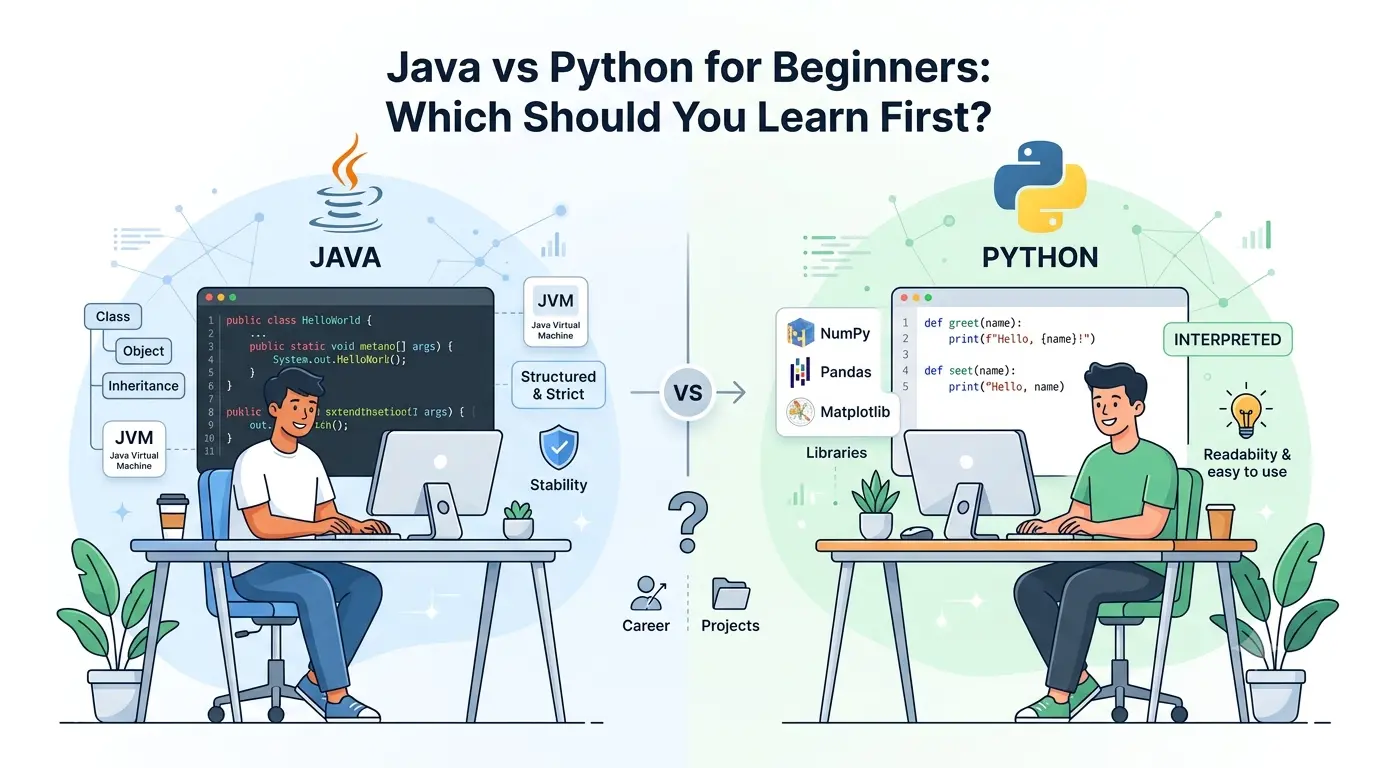
If you are beginner in Coding choosing your first programming language can feel harder than learning the language itself . If you’ve spent more time googling “which language should I learn” than actually writing code, you’re not alone. It’s one of those decisions that feels bigger than it is, mostly because Java and Python keep showing up on every “best language” list, every bootcamp curriculum, and every “top languages” article you find.
The right choice depends less on which language is “better” and more on what you want to build and where you want your career to go. Python is known for readable syntax and is widely used in AI, data science and backend development. Java remains an important language for enterprise software, backend systems and large-scale applications. Recent developer data also shows strong demand for both: Python has seen significant growth, while Java remains one of the major languages used in modern software development.
Let’s break it down properly.
Java vs Python: What’s the difference?
Java and Python both are general-purpose programming languages, but they have different design approaches and are commonly used in different areas of software development
Python is designed around readability and rapid development. The Python Software Foundation describes its syntax as emphasizing readability and notes its use in areas such as rapid application development, scripting and connecting software components.
Java on the other hand, has a strong presence in backend and enterprise development. Its ecosystem includes frameworks such as Spring and Spring Boot, making it a popular choice for developing large-scale server-side applications.
Here’s some idea in both languages, side by side:
| Feature | Java | Python |
|---|---|---|
| Learning curve | Moderate | Easier initially |
| Syntax | More verbose | More concise |
| Typing | Statically typed | Dynamically typed |
| Main strengths | Enterprise, backend, large systems | AI, data, scripting, automation, backend |
| Performance | Generally faster for many CPU-intensive workloads | Generally slower for CPU-heavy workloads |
| Beginner friendliness | Good | Excellent |
| AI/ML ecosystem | Strong | Very strong |
| Backend development | Excellent | Excellent |
| Programming fundamentals | Excellent | Excellent |
Which one is easier to learn?
For most people starting from zero, Python is the easier on-ramp. It’s a genuinely solid, well-designed language. It’s more that Python gets out of your way faster. You spend less time fighting semicolons, curly braces, and type declarations, and more time actually learning what a loop does, or why you’d use a function in the first place. When you’re new to programming, that difference matters more than people expect.
On other hand, java you’ll bump into concepts like classes, static methods, and compilation earlier than you would in Python even for a basic “print something to the screen” program. It’s not harder in a bad way, it’s just less forgiving while you’re still getting your footing.
So which one would you learn first, Java or Python?
If you want the short answer: start with Python unless you already know you want to work specifically in enterprise Java systems or Android development, in which case starting with Java isn’t a bad idea either.Python gets you writing real, working programs faster, with less frustration along the way. Java teaches you habits strict typing, structure, discipline that will make you a stronger developer later, even if it feels like more work up front.
There’s no wrong choice here, only a faster or slower on-ramp depending on what you already know you want to build.
Can You Learn Both Eventually?
Yes, and most working developers do end up picking up more than one language over their career. The skills transfer more than people expect. Once you understand variables, loops, conditionals, and functions in one language, learning a second one is far less about “starting over” and more about learning new syntax for concepts you already know.
A common path looks like this:
- Start with Python to learn core programming concepts without extra friction.
- Build a few small projects, a script, a simple web app, a data project.
- Once you’re comfortable, pick up Java to round out your understanding of typing, structure, and larger-scale systems.
At the end of the day, this isn’t a decision you need to overthink. Neither choice locks you in. Most developers end up learning both eventually, so pick the one that matches what excites you right now, build something small with it this week, and don’t wait for the “perfect” choice.