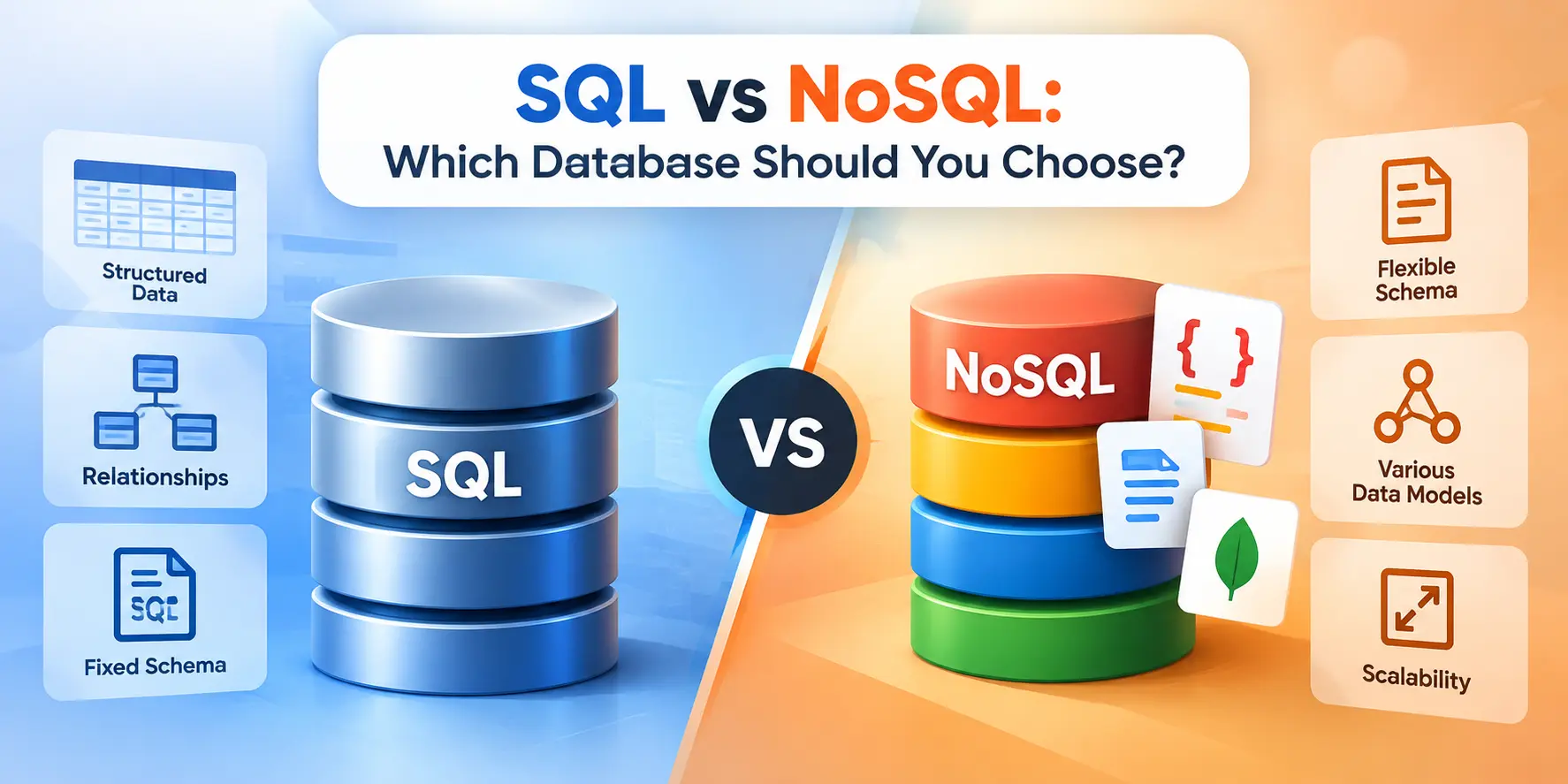
Databases are used to store, manage and retrieve data efficiently. SQL vs NoSQL is one of those debates that comes up the moment you start any new project. The right database depends entirely on what your data looks like, how it changes over time, and how your application needs to scale.
This guide breaks down the real differences between SQL and NoSQL databases.
SQL vs NoSQL: The Core Difference
SQL Databases: SQL database also called as relational database stores data in structured tables with predefined rows and columns, connected through relationships. eg. MySQL, PostgreSQL, and Microsoft SQL Server. (visit: PostgreSQL, MySQL, Microsoft SQL Server).
NoSQL Databases: NoSQL databases store data in more flexible formats such as documents, key-value pairs, wide-column stores, or graphs without requiring a fixed schema upfront. eg. MongoDB, Redis, Cassandra, and DynamoDB.
Here’s what a simple user record looks like in each:
SQL
CREATE TABLE users (
  id INT PRIMARY KEY,
  name VARCHAR(100),
  email VARCHAR(100)
);
NoSQL
{

  "_id": 1,

  "name": "Priya Sharma",

  "email": "priya@example.com",

  "addresses": [

    { "type": "home", "city": "Pune" },

    { "type": "work", "city": "Mumbai" }

  ]

}
Key Differences of both:
| SQL | NoSQL | |
| Data Structure | Tables, rows, columns | Documents, key-value, graph, columnar |
| Schema | Fixed, defined upfront | Flexible, dynamic |
| Relationships | Strong (foreign keys, joins) | Weak or handled in application logic |
| Scaling | Vertical (bigger server) | Horizontal (more servers) |
| Consistency | Strong (ACID compliant) | Often eventual consistency |
| Query Language | SQL (standardized) | Varies by database |
| Best For | Structured, relational data | Unstructured or rapidly changing data |
When to choose what?
Pick SQL when you have:
- Structured data with a clear,stable schema
- Relational data that needs complex joins
- A need for strong, immediate consistency
- Fast lookups by indexed columns
Pick NoSQL when you have:
- Little or no needs of joins
- Data whose shape changes often or varies per record
- Data that must be spread across many servers or regions
- Workloads like caching, sessions, logs, feeds, or catalogs
Can you choose both?
Yes, and a lot of production systems do. This is called polyglot persistence, using different databases for different parts of the same application based on what each part actually needs.
So SQL vs NoSQL question isn’t really about which database is “better”, it’s about which one matches your actual data and workload. SQL gives you structure, strong consistency, and mature tooling. NoSQL gives you flexibility and horizontal scale. Most serious applications today end up using a mix of both rather than picking one exclusively, and that’s a perfectly reasonable outcome not a compromise.